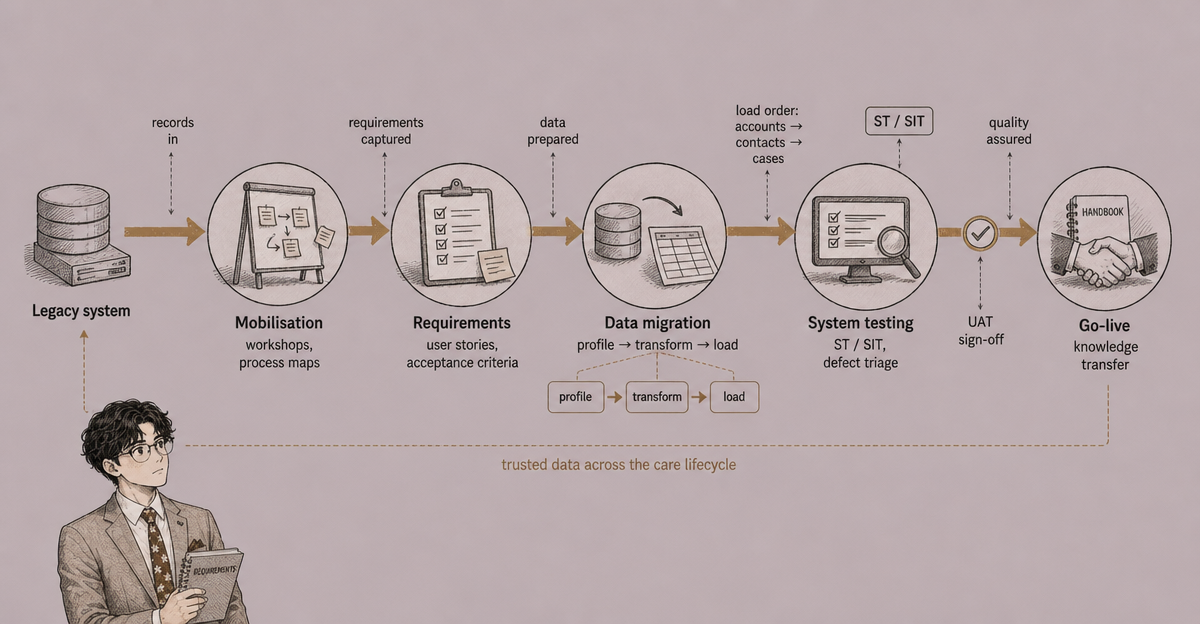
This engagement was my first full-lifecycle Salesforce project — involved from Mobilisation and Scope Definition through to Go-Live support. The client was an Australian aged care and social services provider, and the project replaced a legacy system with a Salesforce-based platform for managing client services, referrals, and care coordination.
Working in aged care adds a layer of rigour: data accuracy, process fidelity, and stakeholder confidence matter more when the end users are care coordinators and the records relate to vulnerable people.
Mobilisation and Requirements
My involvement started at Mobilisation — working alongside BAs, solution architects, and the client delivery team to scope the implementation and establish working assumptions.
I facilitated client workshops to surface current-state processes and map them to Salesforce capabilities. Each workshop produced a business process map that became the foundation for user story authoring.
Outputs:
- Business process maps for core service delivery workflows
- User stories with acceptance criteria drafted collaboratively with BAs and signed off by client stakeholders
- Traceability back from user stories to original business requirements
This grounding in requirements — not just technical delivery — shaped how I approached testing and defect triage later in the project.
Data Migration
Migrating data from a legacy system is rarely clean. Client records, service history, referral data, and care plans all needed to be extracted, validated, transformed, and loaded into Salesforce.
I used Salesforce Data Loader as the primary migration tool, working through:
- Data profiling — understanding the legacy data model and identifying quality issues before they became migration failures
- Transformation mapping — mapping legacy fields to Salesforce objects and fields, with transformation rules documented for audit
- Import execution — loading records in dependency order (accounts before contacts, contacts before cases)
- Migration reporting — success/failure counts, error logs reviewed and reconciled with the client before sign-off
The habit worth carrying forward: profile early and share what you find early. Every legacy dataset has surprises in it, and the difference between a surprise found in week two and the same surprise found at go-live is the difference between a scheduling conversation and a crisis.
System Testing and Defect Triage
I performed System Testing (ST) and System Integration Testing (SIT) across all Salesforce-related user stories, covering:
- Technical implementation (Apex, Flows, custom objects)
- Third-party app integration (external service providers connected to the platform)
- Data migration validation (migrated records displaying correctly in the new system)
Defects were logged, triaged, and coordinated for resolution with:
- Client BAs and testers (business process defects)
- The offshore development team (technical defects)
- Third-party vendors (integration defects)
Defect triage in a regulated environment requires care — distinguishing between a defect in the system vs a gap in the requirements vs a training issue takes experience and close collaboration with stakeholders.
Go-Live and Post-Launch Support
After UAT sign-off and go-live preparation, I supported the transition through go-live — monitoring the system during initial live usage, triaging urgent issues, and coordinating rapid resolution where needed.
The engagement closed with knowledge transfer documentation ensuring the client’s internal team and ongoing support function could maintain the platform independently.
Reflections
This project reinforced that Salesforce delivery isn’t just about writing Apex. Understanding the business domain, facilitating productive workshops, translating ambiguous requirements into testable user stories, and executing a clean data migration are all as important as the technical implementation — especially in a regulated sector where errors have real consequences for real people.
This full-lifecycle exposure informed how I approach every engagement since: starting with requirements clarity, maintaining traceability throughout, and never treating testing as an afterthought.
Client details are generalised. This describes an aged care sector engagement delivered through Deloitte Digital; the client organisation and its data are deliberately omitted. The delivery approach and lessons are as experienced.