When I joined Funlab in July 2023, the platform had just completed a major implementation and was weeks from go-live. I was the only in-house Salesforce developer. The consulting team that built the system was handing over. My job: absorb everything, keep the platform stable, and make it grow.
Over the following six months I managed knowledge transfer, coordinated go-live preparation, conducted end-to-end testing, and took full technical ownership post-launch across 60+ venues in AU, NZ, and US.
The Platform
Funlab runs Strike Bowling, Holey Moley, and a portfolio of entertainment brands. The Salesforce implementation covers the full function booking lifecycle: venue availability queries, quoting, payment collection, document generation, and post-event follow-up.
Three clouds in play:
- Sales Cloud — Opportunities, Quotes, function bookings
- Service Cloud — case management, guest enquiries, payment disputes
- Marketing Cloud — confirmation emails, automated guest communications, upsell journeys
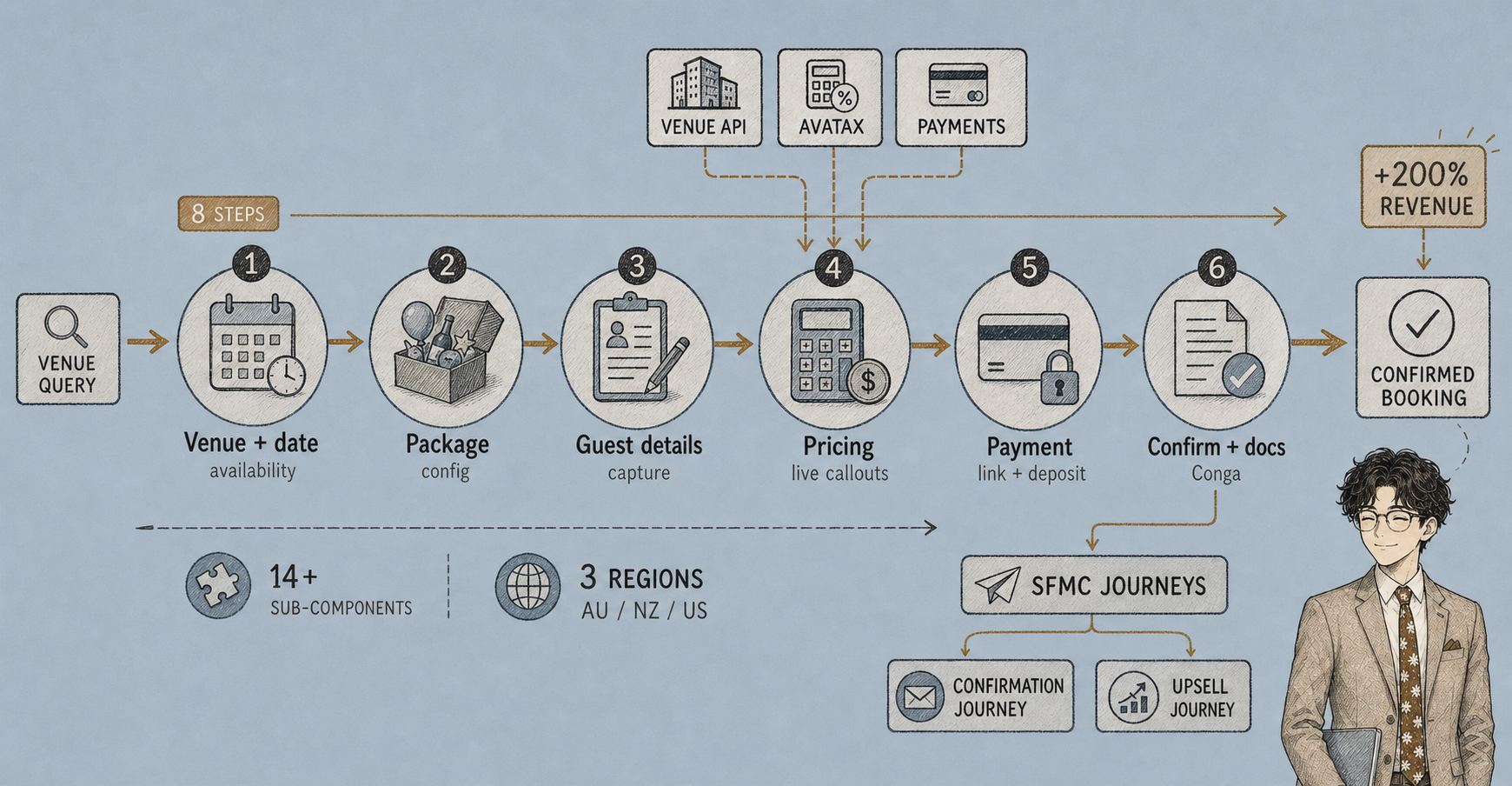
The integration surface was significant: an internal proprietary REST API for venue availability, AvaTax (US tax), two payment providers for payment links, and Conga Composer + Conga Sign (contracts and e-signature).
The LWC Booking Wizard
The centrepiece of the platform is an 8-step Lightning Web Component wizard — the primary interface for creating and editing function bookings across all brands and regions.
Architecture
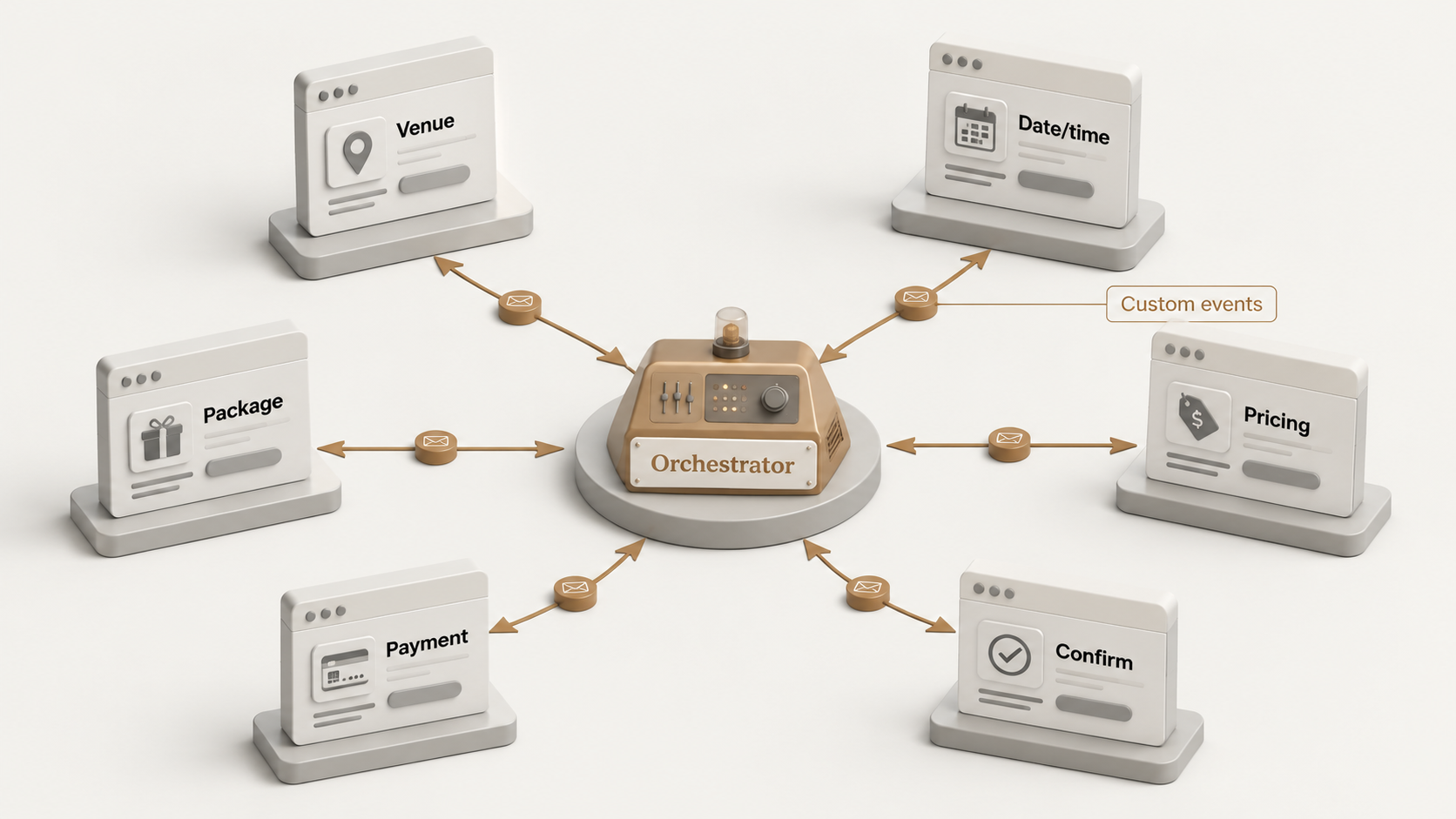
14+ sub-components, each responsible for a discrete step: venue selection, date/time, package configuration, guest details, pricing, payment, document generation, and confirmation. The parent orchestrator manages step navigation and aggregates the booking payload.
No direct component-to-component coupling. Every data update flows through the orchestrator via custom events. This architecture made Jest unit testing tractable — each sub-component can be tested in isolation with a mocked parent.
Real-Time API Integration
Every pricing step makes live callouts:
- Internal venue API — venue availability and capacity in real time
- AvaTax — US tax calculation via asynchronous Queueable Apex, results surfaced before the user proceeds to payment
- Payment providers — payment link generation at checkout step
Multi-region behaviour (AU vs NZ vs US) is driven by Custom Metadata Types — timezone handling, currency display, and tax logic all adapt per venue without conditional logic scattered through components.
Salesforce Multi-Cloud Integration
Beyond the wizard, I integrated Sales, Service, and Marketing Clouds to create a unified guest experience:
- Real-time booking sync — confirmed bookings trigger SFMC Journey Builder to send personalised confirmation emails with booking details
- Automated upsell recommendations — post-booking journeys surface package upgrades and add-ons based on booking type and venue
- Mobile-optimised checkout flows — payment confirmation and receipt delivery optimised for mobile guest experience
This consolidation produced a 69% increase in online conversion rates as the guest journey became seamless across channels.
Payment Stabilisation
The first weeks post-go-live surfaced several revenue-critical payment issues I resolved under live production pressure:
- Business-day deposit calculations — due-date logic was miscalculating across weekends and public holidays; rewrote using a Custom Metadata-driven holiday calendar
- Payment link generation — intermittent failures on certain booking types traced to payload validation gaps in the Apex callout handler
- Payment reminder Batch Apex — timing logic wasn’t correctly scoping AU vs NZ records; added explicit region filters and corrected the cron schedule
CI/CD and Release Management
All changes flow through an Azure DevOps YAML pipeline using SFDX Git Delta — only changed components deploy per sprint, keeping deployment times fast across a large org metadata footprint.
Fortnightly release cadence. ~109 deployment commits over 26 months. Every release coordinated with QA validation in sandbox before promotion to UAT and Prod.
Results
- 200% online revenue growth — the booking wizard is the primary revenue interface across all brands and regions
- 69% increase in online conversion rates — Multi-Cloud integration and streamlined checkout flows
- Platform stable across 60+ venues, 3 regions, and multiple payment providers
- Knowledge successfully transferred and documented; new team members onboarded 40% faster with authored Apex Script Repository and developer guides